
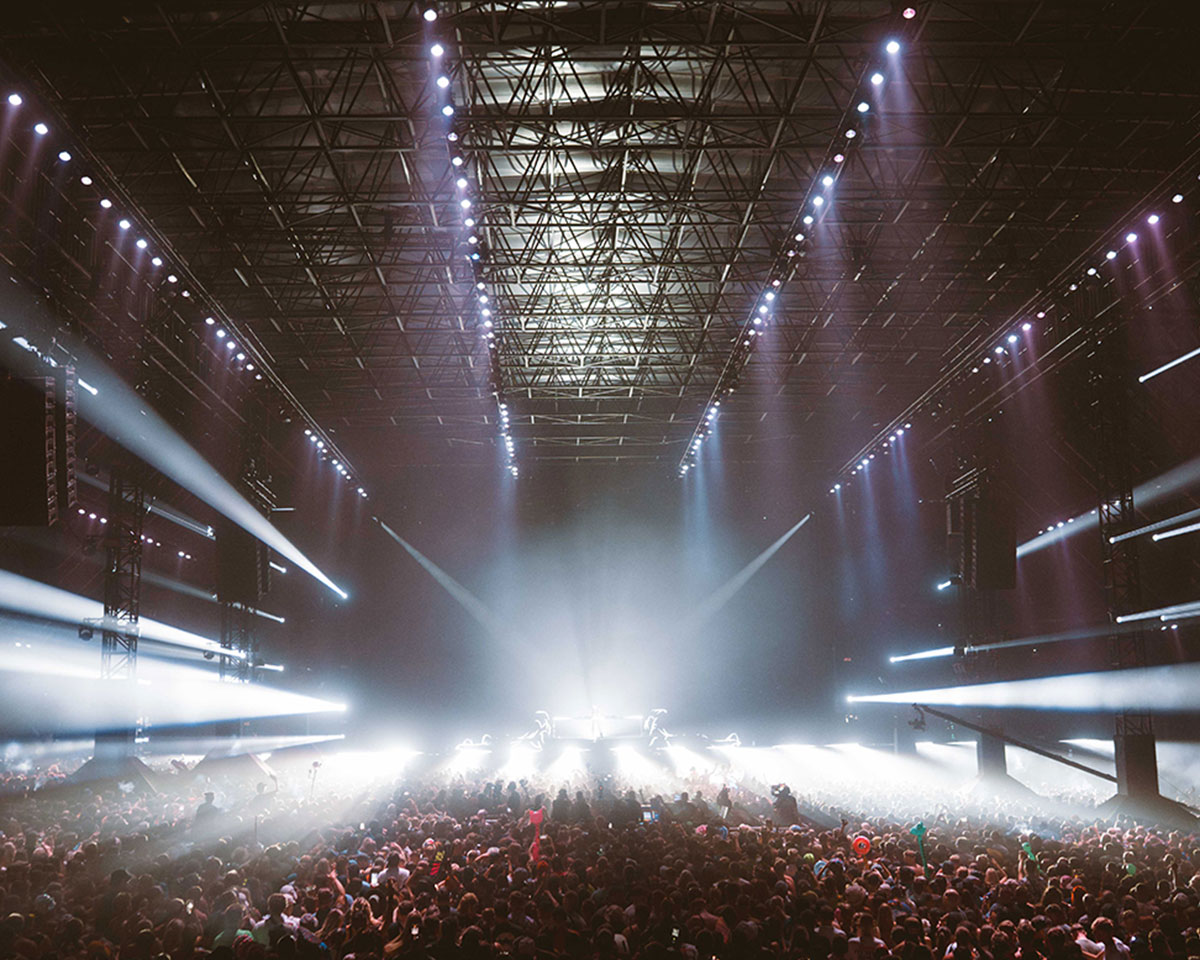
Annual UK EDM festival Creamfields opened its gates once again this summer to more than 80,000 attendees over the course of a weekend. The event held in Daresbury, Warrington hosted 300 artists across 30 stages, including headlining artists Anyma, Martin Garrix and Fisher.
At the centre of the festival sat the Apex Stage, an arena enclosed under an enormous festival tent. The superstructure’s capacity of 30,000 has made this the largest indoor festival space in the world. Helping to bring the artists vision to life was Video Village, a local UK-based facilities company.
Tasked with recording and live streaming multi-camera coverage to social media as well as providing feeds for IMAG, the team deployed a workflow capable of scaling to the unique needs of each artist, underpinned by a Blackmagic Design solution.
Video Village’s custom-built OB van centres around an ATEM Constellation 8K live production switcher with an ATEM 2 M/E Advanced Panel for control, while an ATEM Camera Control Panel provides camera control and shading.
The unit is designed to fully support UHD workflows with full 12G SDI connectivity and single-mode fibre connectivity throughout.
Each of the 40 inputs to the ATEM Constellation 8K can also be distributed at least twice to offer ISO feeds of every input for signal distribution, monitoring, or replays, in addition to the auxiliary outputs from the ATEM.
“It makes the van extremely powerful, offering our clients a compact, affordable, high-end outside broadcast with the ability to deliver demanding technical specifications,” begins Dan Brennan, Technical Manager at Video Village.
“As we built the van specifically for renting out to other companies, it needs to be flexible enough to fulfil any client vision, however they choose to work with it. It’s also well sound proofed, comfortable, and is a great place to work from when you’re parked up literally in the middle of a field,” Brennan explained.
Central to the workflow sits a Blackmagic Videohub 80×80 12G router, providing the backbone for signal distribution. This is supported by 32 fibre inputs using Blackmagic Talkback Converters as interface points, enabling bi-directional video, tally, and intercom, over single mode multicore fibre. This enables long cable runs that can easily be broken out front of house, and can fit easily inside the cable ramps running throughout the venue.
“One of the biggest challenges at Creamfields isn’t just the number of inputs, but rather the sheer number of outputs per source,” Brennan explained. “We have to deliver clean outputs, feed content for IMAG screens and monitor feeds, sometimes all in different frame rates. That’s where the scalability of the production van, and the processing power it has from utilising our built-in Teranex AVs, is crucial.”
“We have recently become a Canare cable distributor, having found that their deployable, lightweight 12G SDI cable options work perfectly with Blackmagic Designs UHD ecosystems,” he enthuses. “They allow us affordable, easy to clean, long distance shielded cable runs, that distribute reliable signals around a festival site.”
The team deployed a multi-camera setup, featuring six URSA Broadcast G2 cameras, and four Micro Studio Camera 4K G2s, placed across the tented arena to maximise coverage.
“One of the prerequisites from our directors was to try and keep everything moving,” he said. “With fast-paced music, dancing lights, lasers, and on-screen visuals, it was crucial that our camera work matched the energy of the performance, capturing the atmosphere without slowing down the energy, while still showcasing the epic staging and visuals.”
To strike this balance, two URSA Broadcast G2 cameras with Blackmagic URSA Studio Viewfinder G2’s were setup front of house. Each URSA Broadcast G2 ran with either 12G Canare SDI cables, or duplex single-mode fibre to a Blackmagic Design Optical Fiber Mini Converter loaded with a Blackmagic Design 12G SFP.
“This is where the URSAs really come into their own for us with the Studio Viewfinder,” Brennan noted. “In fast paced moments, the director can just say ‘hold your shots’ and we can use servo zooms from the B4 broadcast glass to add par focal movement while the director hot-cuts between cameras. Red tally tells the operators that they’re live, or we use green tally and return feeds to match shots and avoid unwanted camera movement.”
“An important aspect of our offerings is that we support the integration of high-end products to satellite around our affordable Blackmagic Design production vehicle for stunning visuals,” Brennan explained. “We had a 24-foot Stanton Triangle Jib, box lens, Ronin R2 and two sliders, to name some of the toys.”
“On this job we used a variety of 4K glass, from a UJ90 box lens, to CJ14’s, CJ24’s, and a Fujinon UA46. The tilt feature in the camera system enabled our experienced vision engineer to slightly shift those characteristically differing green and magenta hues between different brands of glass, which made the colours match perfectly across all cameras,” he described.
Blackmagic Micro Studio Camera G2s were stationed in discreet positions around the arena for a number of alternative angles, such as stage level hero shots and over the shoulder crowd shots. “These little cameras were able to offer us quick repositions and smoothly operated tilts via the Middle Things APC interface. They worked very well in spaces where a larger, operated camera wouldn’t be practical.”
The team explored further ways to elevate the offerings for audiences watching from home.
“We wanted to get closer to the DJ and the crowds to really pull the audience into the show’s energy, so we put a light weight stage gimbal to work. Using a small form factor camera like the Blackmagic Cinema Camera 6K meant that we could get right into the action without standing out against the video wall,” revealed Brennan.
He added, “It was also an opportunity for us to put the camera through its paces with the newly introduced autofocus. It was a challenging environment of moving shots, haze, lasers and changing lighting, and I have to say it didn’t let us down.”
Video Village also tried out the Blackmagic Camera app on an iPhone 16 as part of the workflow.
“We were shooting some in-house social content on a gimbal rigged iPhone when one of the crew suggested trying it live,” Brennan recalled. “With a simple adaptor and the Blackmagic Camera app, we were able to feed it straight into the Constellation using a low latency DJI SDR. It synchronised and worked perfectly, giving us discreet shots from inside the audience.”
“Delivering such a seamless live workflow across AV, live streaming, and social media platforms simultaneously is a massive undertaking, however a reliable solution leaves room for exploration and makes the experience enjoyable not just for the audiences but for the production teams too,” said Brennan.
“It is an important balance to strike, between enhancing the visuals of the performance, and finding those moments in the crowd as the audience interacts with the DJ,” he added.
“There was a beautiful moment at the end of Fisher’s set, when he played Oasis’ ‘Don’t Look Back in Anger’.” He concluded. “All of our cameras, along with the VJ visuals, were shown across the screens on stage. It captured a powerful singalong that stood out from his usual style, creating a wonderful, collaborative, and evoking moment for everyone in Apex.”

