
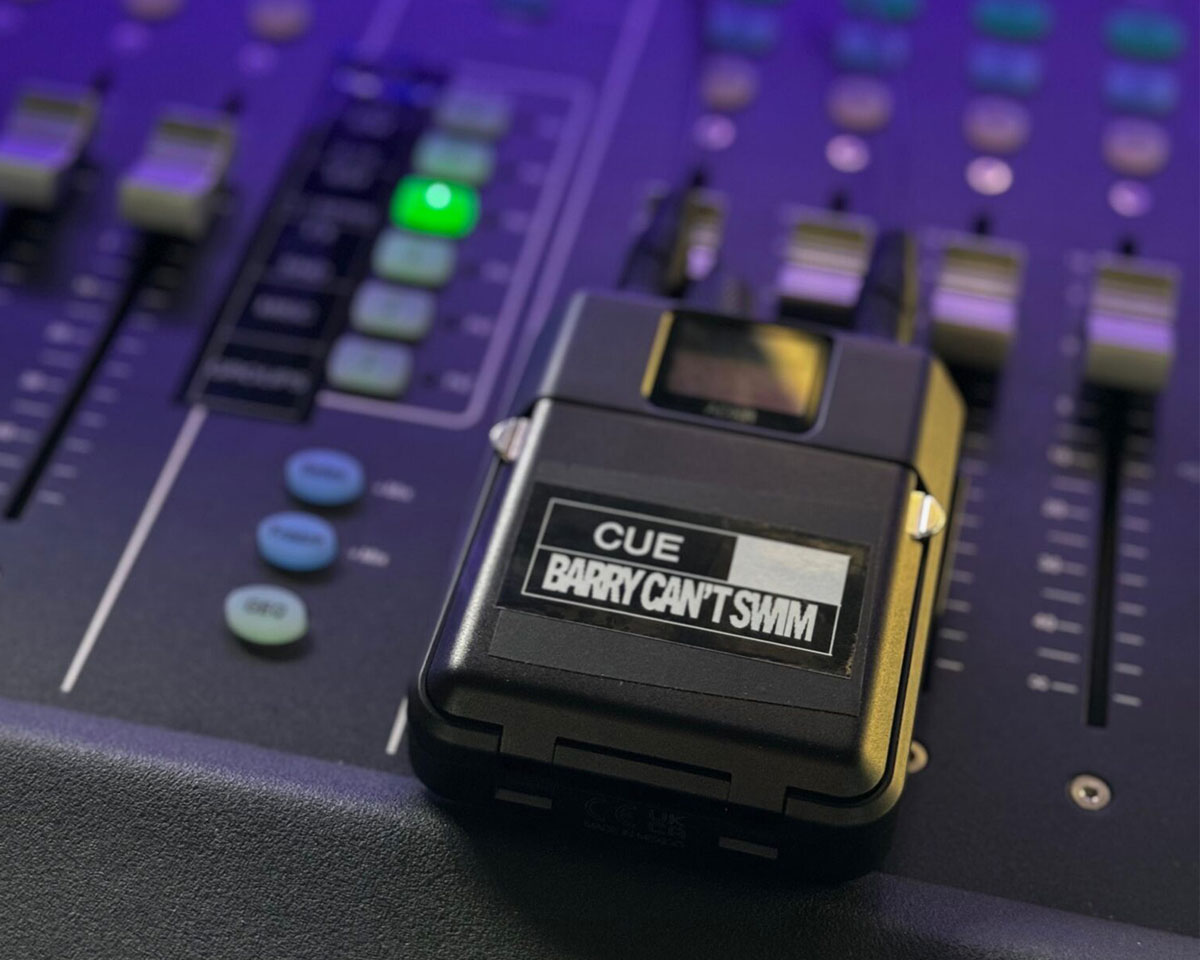
Allen & Heath’s dLive was at the centre of Barry Can’t Swim’s headline show at All Points East in Victoria Park, London. Supplied by Patchwork London, the audio package covered front-of-house and monitors, with a fully networked system providing flexibility and integration across all positions.
At FOH, engineer Greg Smart mixed on a dLive DM0 MixRack with an S5000 control surface, paired with a DX168 expander for outboard integration. Monitor engineer Jane Datony mixed the band on a DM48 MixRack and S3000 surface, with additional monitor engineer Med Rann covering the orchestra on a DM48 and dLive S5000. The audio rig for the show made the most of Allen & Heath’s extensive I/O options, with three DX168 expanders dotted across the stage.
Smart highlighted the reliability of DX168 expanders on stage. “When my role began at Barry Can’t Swim early 2024, I was also mixing monitors for the band. I cannot stress how much time – not to mention weight and cost – has been saved using DX168s as digital satellite boxes for on-stage inputs. As we moved up the bill at major festivals, I felt dubious about a busy stage relying so heavily on something powered and signalled by a single network cable. However, our deployment of three DX168s, one per riser, has been absolutely solid.”
A three-way digital split between the dLive systems was achieved via three pairs of GigaAce cards, masterminded by Datony for the additional 13-piece strings and 4-piece horn sections, and also guest vocalist Låpsley at the All Points East concert, for which Rann was invited in to handle. Smart and Datony each received stems packaged by Rann, with Datony then supplying stems back which included the core band setup. Connectivity was further enhanced with three Dante cards and a SuperMADI card.
“With rehearsal time being really tight, the flexibility to be working with the band, the orchestra, or both across the two monitor consoles really came in handy,” noted Datony. “The ease of routing channels between the three consoles made the integration of the system effortless.”
The audio setup utilised the ease of routing back and forth using tie lines on dLive systems. Orchestra monitor engineer Med Rann managed IEMs while also creating submixes of the orchestral stems for FOH and band monitors. “The submixes meant Greg and Jane didn’t need to deal with all the extra inputs in their busy show files,” he explained.
For strings, Rann relied heavily on MCAs to manage changes efficiently. “I had 17 mixes to throw together quickly and efficiently for the strings section, it was super important to be able to reach for as few faders as possible when getting asked for mix changes.”
The orchestra setup benefited from a flexible comms approach. “Having my tech, Jon, roaming the stage during rehearsals with a wireless switch mic was invaluable,” notes Rann. “We set our two shouts up to duck the comms feeds from Jane, and used direct outs instead of tie lines to send back to Jane to add to the general comms for everyone else.”
Datony’s console handled additional requirements including guest vocal inputs and comms for the show’s stage manager and musical director, which she distributed across the system. “Med controlled when his crew comms were and weren’t live for us so he could line-check strings, while myself and the band got on with other work in our ears, and Greg was working on VSC. The three-way console workflow proved very efficient under time constraints, and the flexibility allowed us to manage a sizeable comms system.”
Making use of dLive’s compatibility, Datony adapted her session file for a larger surface without the need for conversion, making extensive use of scenes and dLive’s auto-tracking to carry updates across the show. “During that week we had to keep the show quite modular – we played an original line-up in Paris, then the expanded line-up with an 18-piece string/brass section plus vocal guests at All Points East, and finally a reduced version with a string quartet in Bristol the following day. I had to be really flexible and prepared with my file for these different scenarios.”
The audio engineers utilised dLive’s Actions extensively, with Datony setting up ABCD inputs across all input channels, enabling quick switching between live sources, local virtual soundcheck, and the virtual soundcheck being played at FOH.
Smart used Bookmarks to toggle between the Dyn8 overviews on his LRSF Matrices to check for overcompressing. “Toggling Action Recall within Softkeys is very powerful for flipping between your ABCD Ip: live stage inputs and your virtual soundcheck channels,” he adds. “In the past I’ve had to exclude my drum inputs for them to rehearse along with the live show. In Actions, because it’s a Source Assign screen and not a Patch screen, it’s very easy to use.”
All three dLive MixRacks, the heart of the system, were equipped with RackUltra FX – a collection of 11 new algorithms for dLive.
At FOH, Smart migrated the majority of his effects to RackUltra FX with ease. “I’m known to obsess over single entities within my mix,” he explained. “Migrating to RackUltra FX was painless with minimal over-obsessing. The reverbs sound a lot cleaner and you can really hone in on achieving the desired effect, whether it’s that subtle touch over a vocal on Spaces, or a bursting snare on Plate. In a pinch, you can find a decent starting point by flicking through the Library Presets before customisation.”
Smart also experimented with Rhythm Delay, introduced with dLive’s V2.1 firmware. “With the V2.1 update just released, I had to try the new Rhythm Delay over Låpsley’s guest vocal in the track ‘Woman’. Although I had just seconds to dial this in during APE soundcheck, I was determined to emulate the sound of the record. Being super accurate, Rhythm Delay made this really enjoyable. And, as I had virtual soundcheck to work on later, I happily threw Rhythm Delay up for the first time to nearly 40,000 people with great results.”
The Barry Can’t Swim headline show was Datony’s first time employing the new Spaces reverb. “It was incredibly easy to achieve detailed, realistic drum reverbs without the harsh HF you sometimes get in live environments. The additional channel processing available on the RackUltra FX sends and returns made sculpting a specific sound a dream,” she commented.

